








What a transport and freight forwarding website needs to win orders

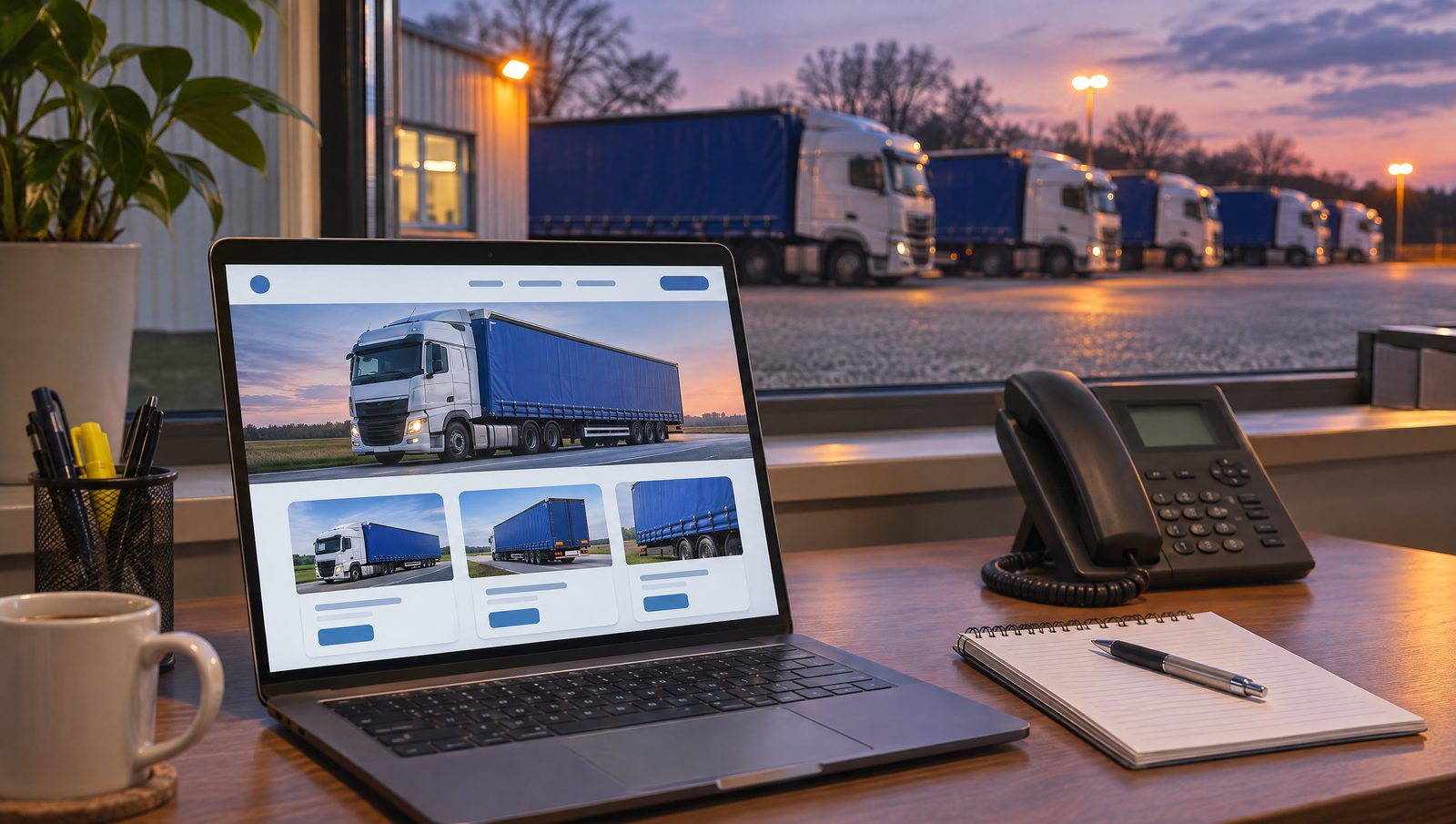
A transport company website has to answer three questions for a shipper before they pick up the phone. Can you carry my load, on which route, and how quickly will I get a quote? If the answers are buried in a single “about us” paragraph, the forwarder closes the tab and calls the next company in the search results.
Below is a list of what a carrier's or freight forwarder's website should include, with examples from two companies we built websites for. Mardo is a carrier from Radomsko and Bacargo a freight forwarder from Wieluń.
Who visits a transport company website?
Before the first subpage is built, it is worth writing down who will visit it. In transport there are usually three groups, and each of them is looking for something different.
- Shippers and forwarders. They check whether you have the right vehicles, routes and paperwork, and want to send an enquiry quickly.
- Drivers looking for work. In an industry short of drivers, the website is one of the main recruitment channels.
- Partners abroad. They compare carriers from several countries and drop the ones whose website is only in Polish.
What does a carrier's website need?
| Element | What to show | Example |
|---|---|---|
| Fleet | types of vehicle combination, load space dimensions, payload, number of vehicles | Mardo, a fleet subpage featuring the Volume Master 120 m³ combination |
| Services | types of transport and cargo, each described separately | Bacargo, with road, sea and air freight forwarding on separate pages |
| Routes | countries and routes the company runs regularly | a map or a list of countries |
| Order process | what happens between the enquiry and delivery | Mardo, with an order placed in three steps |
| Numbers | years in business, number of combinations and drivers, kilometres covered | Mardo, with 30 years, 40 combinations of 120 m³ and 42 drivers |
| Quote form | route, type of cargo, date, contact details | a form with spam protection |
| Language versions | at least Polish and English | Mardo and Bacargo, both in PL and EN |
| Careers | jobs for drivers and forwarders, terms, contact | Bacargo, with a Careers tab |
A fleet described with specs, not adjectives
“Modern fleet” tells a forwarder nothing. Dimensions, payload and the number of vehicles do. Mardo carries high-volume loads, so its most important subpage is the fleet, with the Volume Master 120 m³ combination, its dimensions and payload. Bacargo got a catalogue of 10 vehicle types, so a client can see straight away whether the company can handle their load.
A table or cards work well here, with the vehicle type, load space, payload and a photo. Photos of the real fleet in the company's livery build more trust than stock images.
The order process in a few steps
A client booking a new carrier for the first time wants to know what happens after they send an enquiry. On the Mardo website the order process is set out in three steps. A block like this cuts down the calls asking “so what happens next?” and shows that the company runs an orderly operation.
The quote form, short but specific
The form should collect what a forwarder needs to price the job, and nothing more.
- Loading and unloading points.
- Type of cargo, weight or number of pallets, dimensions.
- Loading date.
- Name, company, phone and email.
Every extra field lowers the number of enquiries that get sent. Spam protection works better as an invisible check than as a test that makes people retype letters.
The English version is not an extra
A carrier that drives across Europe deals with clients from many countries. Before the rebuild, the Mardo website had not changed since at least 2011 and had neither a mobile nor an English version. Today a client from abroad gets a website in a language they understand. Bacargo added an English version without changing its identity, because the brand and the website were prepared for it from the start.
Rebranding and a new website, together or separately?
A new website often comes with a rebrand, and that is a good moment to do both projects together. For years Mardo signed itself “s.c.” (a civil partnership), even though it had been a limited company (sp. z o.o.) since 2016. The refreshed mark and the new website went live together and completed that change. You will find the details in the Mardo case, and the story of a freight forwarder starting from scratch in the Bacargo case.
On a phone in the cab, at a desk in the office
Forwarders check out a carrier at their desk, but drivers look for work on their phones, often in the cab. The website has to work on a small screen, load quickly on a weak signal and have a phone number you can tap to call.
We build websites for transport and logistics companies, from fleet pages to quote forms. The scope of our work is described under services. If your website doesn't show your fleet or has no English version, get in touch.
Frequently asked questions
Does a transport company website need an English version?
Yes, if the company drives abroad or works with forwarders from other countries. A partner from another country compares carriers by their websites and rejects the ones they cannot understand. The English version should cover at least the fleet, services, routes and the quote form.
What should a transport quote form include?
Loading and unloading points, the type of cargo with its weight or number of pallets, the date and contact details. That is enough for a forwarder to give an initial quote. Every extra field reduces the number of enquiries sent, so it is better to ask for the details over the phone.
How should a carrier show its fleet on its website?
In a table or cards with the vehicle type, load space, payload and number of vehicles, with photos of the real vehicles. Forwarders look for specs, not adjectives, so “modern fleet” without numbers does not help them decide.
Can a website help recruit drivers?
Yes. A careers tab with working conditions, a description of the routes and a simple way to get in touch is one of the main channels through which drivers find their way to a company. It has to work on a phone, because candidates often browse job offers while on the road.
Co-founder, art director. Designs visual identity systems for demanding clients, with the people who will use them in mind.