







Company vehicle wraps. How to design fleet graphics that read from a distance

A company vehicle wrap is an advert that drives through the places where your customers are, every day. For it to work, a passer-by has to understand within a few seconds who you are, what you do and how to get in touch. Everything else on the side of the vehicle is extra.
Below we explain how we design fleet livery, from the vehicle template to the print files, using a tractor unit and trailer for Giewont Chemia and coal lorries for Broda Trans as examples.
What has to be visible on a company vehicle?
People see a vehicle in motion, from a dozen or so metres away and often at an angle. The side of a vehicle holds far less than it seems when you design on a screen.
| Element | Why | Example |
|---|---|---|
| Name and logo | so people remember the company | a large logo in the middle of the Giewont Chemia trailer side |
| What the company does | so people know whether it is for them | products and a slogan on the Broda Trans lorry body |
| Phone number or website | so people can order | the order line on the side of the tipper |
| A calm background | so the logo and lettering stay legible | the middle of the trailer side, free of detail |
The most common mistake is putting a flyer on the vehicle, with a dozen or so services, photos and small print. From a distance it all merges into a colourful blur.
Graphics that fit the industry
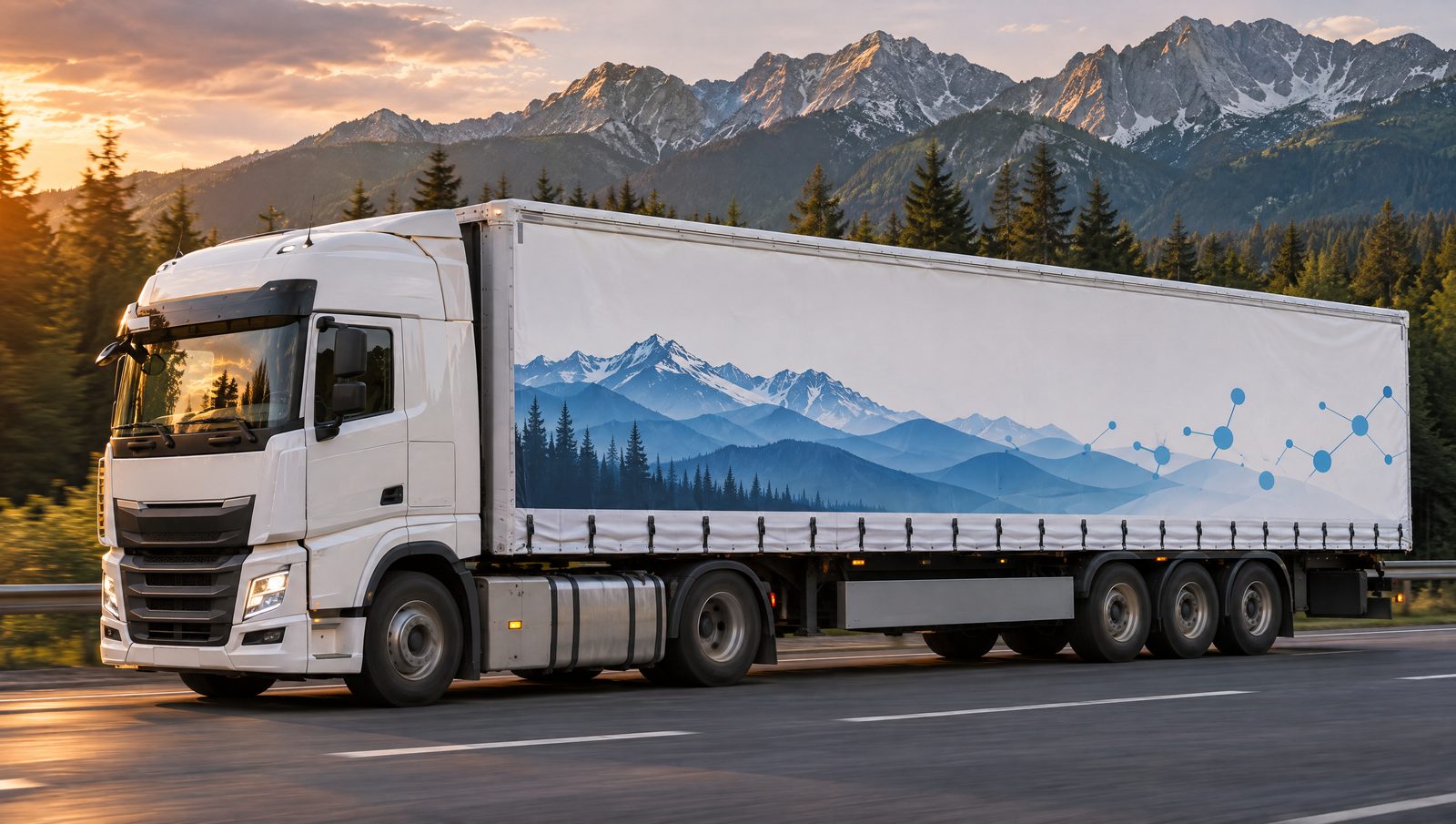
Giewont Chemia makes cleaning and disinfection products for meat plants, dairies, bakeries and the transport sector. The truck and trailer deliver to food plants, where hygiene and trust matter, and the trailer has to look clean even after thousands of kilometres. The design combines the mountains from the company name with chemical molecules and leaves plenty of calm background.
Broda Trans sells coal and solid fuel with delivery to the door. The coal lorry drives every day through the same housing estates it delivers to, so the side says what the company sells and how to order before the lorry turns the corner. The lorry bodies carry the slogan “Zadbaj o ciepło w swoim domu” (Take care of the warmth in your home), and the tipper has a pattern made from fuel textures and the phone number.
The vehicle template, because design starts with dimensions
Every vehicle model has different body creases, handles, windows, air intakes and sliding doors. A design made on a generic drawing of a vehicle ends up with lettering cut through by a door handle or a phone number hidden in a crease.
- Exact model and year. The same model with a different wheelbase or roof height has different dimensions.
- A template to scale. From the vinyl manufacturer, a template library or a measurement of the vehicle.
- Dead zones. Handles, hinges, body creases and door gaps. We never put text or faces there.
- Each side separately. The left and right sides differ in their doors, fuel filler and sliding doors.
For Broda Trans we prepared dimension templates for every vehicle, and designed the MAN lorry body in two versions, white and black, because the fleet has vehicles in both colours.
Print files. 1:10 scale and bleed
The graphics on a trailer are well over ten metres long, so the files are prepared to scale. Each panel of the Giewont Chemia trailer has its own 1:10 file with 5 cm of bleed on the edges, which the installer uses to fit the vinyl to the structure. Without bleed, any inaccuracy in fitting leaves a white strip along the edge.
Before printing, check with the wrap company the resolution of the images at scale, how the design is split into print panels and where the joins fall, so that they do not land on lettering.
The back of the vehicle and the QR code
The back of a vehicle is what other drivers look at longest, stuck in traffic or waiting at the lights. On the roller shutter of the Giewont Chemia trailer we placed a QR code that leads to the company website. The code has to be large, high-contrast and positioned so that no hinges or locks cut across it.
Full or partial wrap?
A full wrap changes the colour of the whole vehicle and has the strongest impact, but it costs more and takes longer to fit. A partial wrap, meaning the logo, lettering and graphics on part of the bodywork, is enough for white vans and cheaper for a large fleet. The choice comes down to the number of vehicles, their colour and how long the company plans to keep them.
Windows are subject to light transmission rules, so the windscreen and front side windows usually stay free of graphics, while the rear windows get perforated vinyl that the driver can see out through.
A vehicle wrap is part of your visual identity, so it is best designed together with the rest of the brand. See our services or get in touch.
Frequently asked questions
What should go on a wrapped company vehicle?
The company name and logo, a short line on what you do, and a phone number or website address. All of it on a calm background and at a size that is legible from a dozen or so metres. A list of every service and small photos merge into a single blur from a distance.
What scale are trailer wrap files prepared at?
Usually 1:10, with bleed on the edges. On the Giewont Chemia trailer, each panel has a separate 1:10 file with 5 cm of bleed, and the photos need enough resolution once they are enlarged to full size.
Full or partial wrap, which should you choose?
A full wrap has the strongest impact and changes the colour of the vehicle, but it costs more. A partial wrap, with just the logo, lettering and some graphics, works well on white vans and for a large fleet. The decision depends on the number of vehicles and how long you plan to use them.
Can you put graphics on company vehicle windows?
The rear windows can be covered with perforated vinyl that the driver can see out through. The windscreen and front side windows are subject to light transmission rules, so they usually stay free of graphics. Confirm the details with your wrap company.
Co-founder, art director. Designs visual identity systems for demanding clients, with the people who will use them in mind.